Top Permanent Tattoo Artists in Pune: Safety, Rules and How to Choose
Short answer: A permanent tattoo is ink placed in the dermis, the second layer of skin, which is why it stays for life. Done at a professional studio with single-use needles and sealed ink it is safe for most healthy adults. It is legal in India at 18, it does not stop you donating blood after the standard waiting period, and most government and defence services allow it depending on placement. The artist you choose matters more than the design, because a permanent mistake is permanent too.
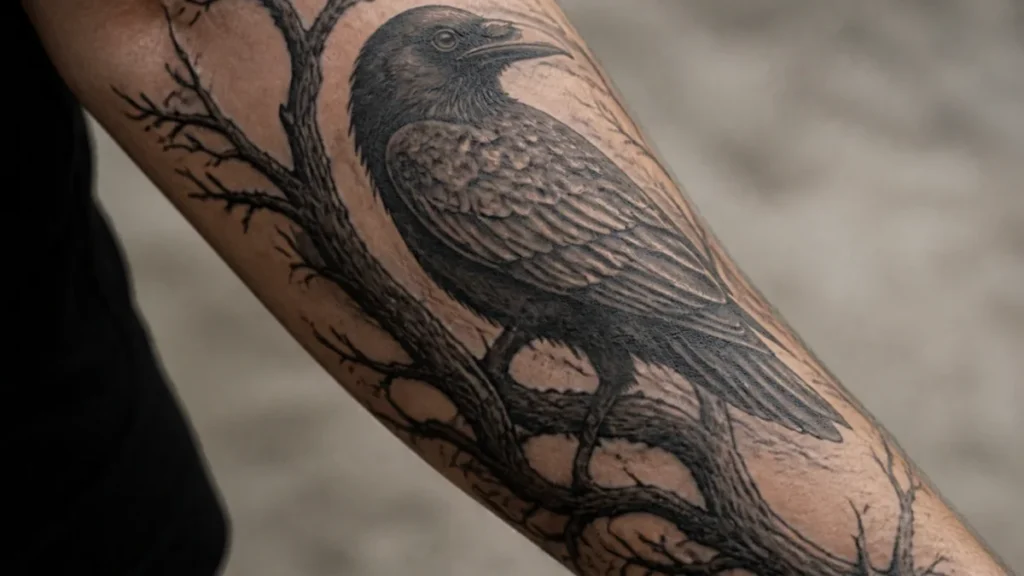
Most people searching for a permanent tattoo artist in Pune are not comparing portfolios yet. They are asking a quieter question first: is this actually safe, and am I going to regret it?
That is a fair question, and most studio pages skip straight past it to the booking button. This guide answers it properly — what permanent actually means, the health and job questions people genuinely worry about, and how to judge an artist when the result cannot be undone. We run Machu Tattoos in Baner, so we have a stake in this. We have still written it the way we would explain it to someone sitting across the table.
The short version
- Permanent means the dermis. Ink sits below the layer your body sheds, which is why it does not wash off.
- It is safe when the setup is right — single-use needles opened in front of you, sealed ink, a wrapped station.
- 18 is the line in India. No reputable studio tattoos a minor, with or without a parent present.
- Blood donation: you can donate after the standard waiting period set by the blood bank.
- Government and defence jobs: usually allowed, with rules about placement — check your service’s own circular before you book.
- It fades, it does not vanish. Sun, hands and feet age a tattoo fastest.
- Removal exists but is slow and costly — several laser sessions, never a clean erase.
On this page
What makes a tattoo permanent
Your skin has an outer layer that renews itself every few weeks. Anything sitting in that layer — henna, a transfer sticker, a “semi-permanent” ink — leaves with it.
A permanent tattoo goes deeper. The needle places pigment into the dermis, the layer underneath, which does not shed. Your immune system surrounds the pigment particles and holds them there. That is the whole mechanism, and it is also why the result depends so heavily on the artist: go too shallow and the design fades out within a couple of years, go too deep and the lines spread and blur.
That single judgement — needle depth, held steady for hours — is most of what separates a tattoo that still looks sharp in ten years from one that looks like a smudge in three.
| Type | Where the ink sits | How long it lasts |
|---|---|---|
| Henna / mehndi | On the skin surface | 1–3 weeks |
| Transfer or sticker tattoo | On the surface | A few days |
| “Semi-permanent” ink | Upper skin layers | Months, and it often fades unevenly |
| Permanent tattoo | Dermis | Life, fading slowly |
Is a permanent tattoo safe?
For a healthy adult, at a studio that follows proper procedure, yes. Tattooing breaks the skin, so it carries the same category of risk as any minor procedure — and the same answer: the risk lives in the setup, not in the ink itself.
What a safe setup looks like
- Needles opened from sealed sterile packaging in front of you, every single time
- Fresh gloves, changed whenever the artist touches a phone, a door or their face
- Machine, cables and lamp wrapped in disposable film
- Ink poured into single-use caps, never reused from an open pot
- A sharps bin in the room, not a dustbin
- A written consent form that asks about allergies, medication and medical history
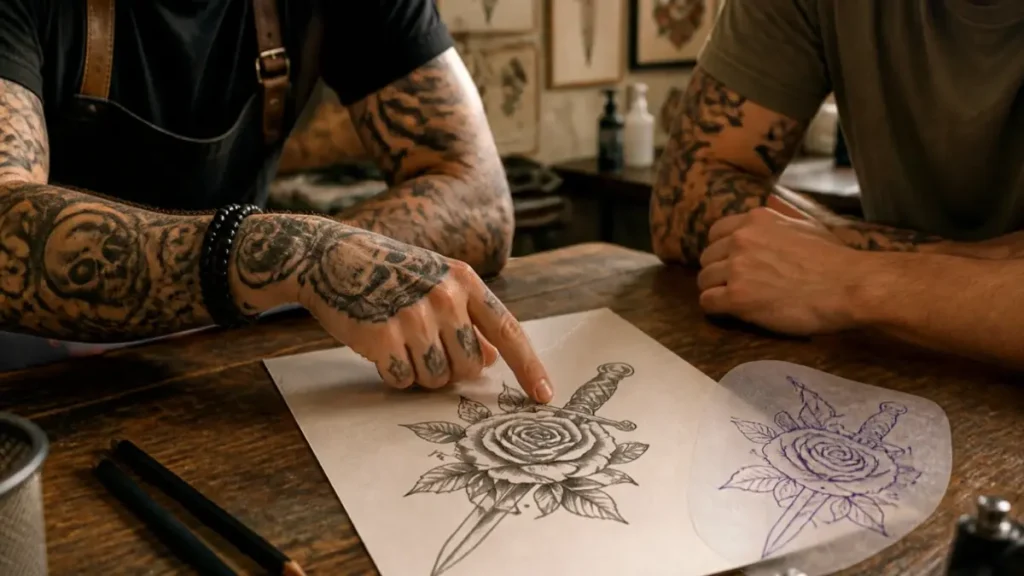
When you should wait or check with a doctor first
- You are on blood thinners, or have a bleeding or clotting disorder
- You have diabetes that is not well controlled, or any condition that slows healing
- You have a skin condition such as psoriasis or eczema active on the area
- You have a known reaction to certain pigments — red inks cause reactions more often than black
- You are pregnant or breastfeeding — most studios, including ours, will ask you to wait
- You are unwell, run down or have taken alcohol that day
None of these are automatic refusals except pregnancy and alcohol. They are reasons to tell your artist, so the session can be planned around them. An artist who never asks is the thing to worry about.
What normal healing looks like
Redness and swelling for a couple of days, then flaking and itching for about a week, then a settled look in three to four weeks. What is not normal: spreading redness after day three, heat, pus, or fever. That needs a doctor, not a WhatsApp message to your artist.
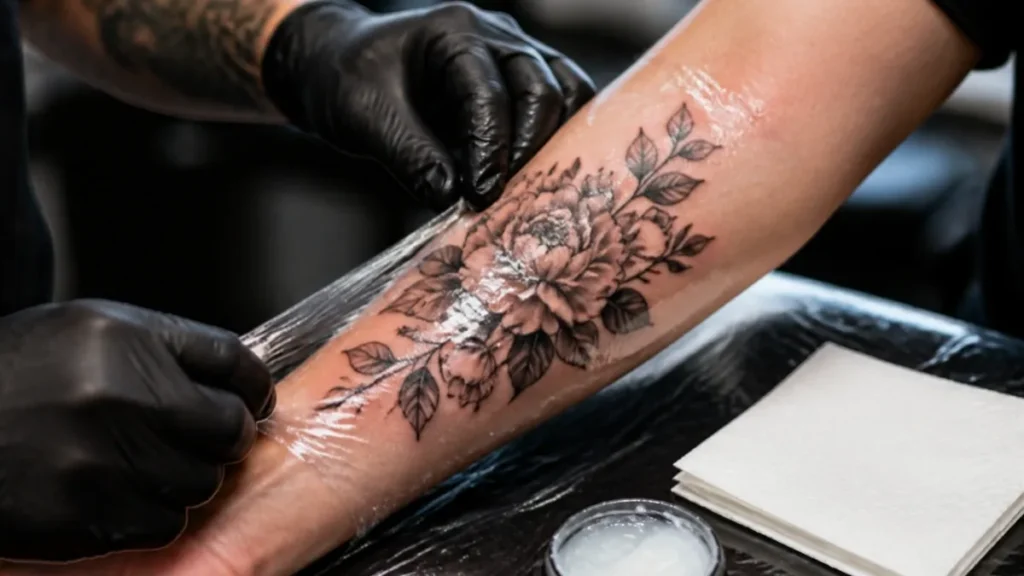
Age, jobs, blood donation and the rules people ask about
These five questions come up in almost every first consultation, so here they are in one place.
Is there an age limit?
Yes. 18. No professional studio in Pune will tattoo a minor, and a parent’s permission does not change that. If a studio offers to, that tells you everything you need to know about the rest of their standards.
Can I donate blood after a permanent tattoo?
Yes, after a waiting period. Blood banks in India apply a deferral after any skin-piercing procedure — commonly six months, though the exact period is set by the blood bank and can differ. It is a delay, not a ban. Tell them you have a recent tattoo and they will tell you when you are eligible.
Are tattoos allowed in government and defence jobs?
Usually yes, with conditions about placement, and the conditions differ by service. Several uniformed services restrict tattoos on exposed areas such as the face, neck and hands, and some have separate provisions for candidates from communities where tattooing is customary. Rules are revised from time to time.
So: if you are preparing for a specific service, read that service’s own current recruitment notification before you book, not a blog — ours included. And if you are even considering that path, keep the tattoo somewhere a sleeve covers.
Does a tattoo affect an MRI or medical tests?
Very rarely, and mostly with large, heavily pigmented older tattoos. Tell the radiographer you have one. It is almost never a reason to cancel a scan.
Is it allowed in my religion?
That is not a question we can answer for you. What we can say is that we tattoo deity designs every week for people who find it an act of devotion, and we also turn work away when the placement would cause someone trouble at home. If you are unsure, talk to your family before you book, not after.
Does it hurt, and for how long
It hurts, but less than most people expect, and the pain is very unevenly spread. What you feel is a scratching, hot sensation rather than a sharp stab, and most people settle into it within the first fifteen minutes.
| Placement | Pain level | Why |
|---|---|---|
| Outer arm, outer thigh, calf | Low | Muscle underneath, nerve endings further apart |
| Forearm, shoulder, upper back | Low to moderate | The easiest places for a first tattoo |
| Chest, inner arm, stomach | Moderate | Thinner skin, more sensitive |
| Hand, foot, neck | High | Skin sits close to bone |
| Ribs, spine, ankle | Highest | Almost no padding between needle and bone |
Practical things that genuinely help: eat properly beforehand, sleep well, no alcohol the night before, wear something that gives easy access to the area, and ask for a break whenever you need one. Numbing creams exist, but tell your artist before the session rather than turning up already numbed — it changes how the skin takes ink.
How long it really lasts
Permanent does not mean unchanging. The design stays for life; how sharp it stays depends on three things.
- Sun. The single biggest ager of tattoos. Sunscreen on a healed tattoo is the cheapest thing you can do to protect it.
- Placement. Hands, fingers and feet fade fastest — constant washing, friction and sun. Ribs, back and outer arm age slowest.
- Line weight and style. Very fine lines packed closely together will soften first. Solid black work holds longest.
A well-placed piece on the forearm can look close to new at ten years. The same design on the side of a finger may need a touch-up within two. That is not a quality problem, it is anatomy, and any honest artist will warn you before they start rather than after.
If you change your mind
You should assume you cannot undo it. That is the honest framing, and it is the one that leads to better decisions.
Laser removal does exist and does work, but it is worth knowing what it actually involves: several sessions spaced weeks apart, real cost, real discomfort, and a result that is usually a faded ghost rather than clean skin. Black ink responds best; colours, especially greens and light blues, are stubborn. A cover-up by a skilled artist is often the better route, and it needs the new design to be larger and darker than the old one.
The practical conclusion: spend the extra hour at the consultation. Changing a drawing is free. Changing a tattoo is not.
How to choose an artist for something permanent
This is where the decision actually gets made, and it takes about ten minutes over WhatsApp.
1. Ask for healed photos, six months or older
The most useful question almost nobody asks. A fresh tattoo is swollen and shiny, which hides blown lines and patchy shading. The same tattoo at six months shows whether the artist held the right depth. A good artist has these ready; a weak one changes the subject.
2. Confirm who is actually holding the machine
Studios market as a brand but tattoo as individuals. The portfolio you liked may be the senior artist’s while your slot is with someone two years in. That is not automatically a problem — but see that artist’s healed work in your style first.
3. Watch the first five minutes of the consultation
A good artist asks before answering: what the design means, where it will sit, how your skin behaves, whether you need it coverable at work, what your medical history is. One who opens with a price and a date is selling a slot, not planning a tattoo.
4. Listen for the word no
An artist who agrees to everything is the biggest red flag in this industry. A detailed mandala at two inches will close up. A deity below the waist will cause trouble at home. Fine script on the side of a finger will blur. If nobody is telling you any of this, nobody is thinking about the version of this tattoo that exists in ten years.
What decides the price
We do not publish a rate card, because no two designs take the same number of hours, so any figure on a web page would be wrong for most people reading it. What is useful is knowing how the number is built, so you can judge any quote you are given.
| What moves the price | Why |
|---|---|
| Hours in the chair | Everything else is downstream of this. Detail and shading cost time, and time is what you are paying for. |
| Shading vs clean line work | Shading is slow and unforgiving. A line piece and a shaded piece of the same size are not the same job. |
| Custom drawing vs flash | A design drawn for your body takes hours before the session starts. |
| Placement | Ribs, hands, feet and neck are slower and need more breaks than the same design on a forearm. |
| Number of sittings | Large or detailed work is planned across sessions, with healing time in between. |
Send us the design, the size and the placement and an artist gives you a number for your piece rather than an average. If a quote comes in far below everyone else’s, ask what needles and ink they use — on permanent work, that is usually where the saving comes from.
Machu Tattoos, Baner
Machu Tattoos was founded by Suresh Machu, who is internationally recognised and widely regarded as one of the best tattoo artists in India. He backed his own training with an advanced certification from Miami Ink, and built the studio on a simple idea: a permanent tattoo deserves to be treated like a permanent decision.
Our Pune studio is on Baner Road, which makes it the practical choice if you are anywhere in the western corridor — Baner, Balewadi, Wakad, Hinjewadi, Pashan, Aundh or Bavdhan.
How we work on permanent tattoos
- The consultation is free. You see the artwork, ask for changes, and nothing goes on skin until you approve it.
- Single-use needles, opened in front of you, every session.
- Medical history first. We ask about allergies, medication and conditions before we discuss the design.
- Aftercare explained in person and in writing before you leave, plus someone to message if healing does not look right.
- Large work planned across sittings, not forced into one marathon session.
What we are best at
- Fine line and minimal work
- Deity and spiritual pieces — Ganesha, Shiva, Om, mantras and mandala work
- Black and grey realism
- Professional piercing with single-use equipment
When we will tell you not to do it
- A design too small for its detail. We will ask you to change the style or the size rather than shrink it and watch it blur.
- A deity design below the waist. We will talk you out of it, and decline if you insist.
- Same-day walk-ins for large custom work. We draw first.
- A tattoo you are getting in a hurry, angry or heartbroken. Come back in a month. If you still want it, we will do it properly.
To see the work rather than read about it, our Pune studio page has the portfolio, address and directions. If you want to know which artist suits your style, read our guide to tattoo artists in Pune.
FAQs
If you are still deciding on the design itself, read our breakdown of the 10 tattoo styles in Pune and how to pick the right artist for each — it covers minimum size, number of sittings and the one question that separates a specialist from a generalist.
Are permanent tattoos safe?
Yes, for a healthy adult at a studio that follows proper procedure. Needles must be single-use and opened in front of you, ink poured into fresh caps, the machine and lamp wrapped, and a sharps bin in the room. Tell your artist about any medication, allergy or skin condition before the session. If any of those basics are missing, walk out.
What is the age limit for a permanent tattoo in India?
18. No professional studio will tattoo a minor, and a parent’s consent does not change that. A studio willing to ignore it is telling you how it treats its other standards.
Can I donate blood after getting a permanent tattoo?
Yes, after a waiting period. Blood banks in India apply a deferral after any skin-piercing procedure, commonly six months, though the exact period is set by the blood bank. It is a delay, not a permanent bar — just tell them you have a recent tattoo.
Are permanent tattoos allowed in government and defence jobs?
Usually yes, with conditions about placement, and the conditions differ by service. Several uniformed services restrict tattoos on exposed areas such as the face, neck and hands. Rules are revised from time to time, so read your service’s current recruitment notification before you book, and keep the tattoo somewhere a sleeve covers.
How long does a permanent tattoo last?
For life, but it softens. How sharp it stays depends on sun exposure, placement and line weight. Forearm and back pieces age slowly; hands, fingers and feet fade fastest because of washing, friction and sun. Sunscreen on a healed tattoo is the cheapest protection there is.
Does a permanent tattoo hurt?
It hurts, but less than most people expect, and it depends heavily on placement. Outer arm, thigh and calf are easiest. Chest, inner arm and stomach are moderate. Hands, feet, neck, ribs and spine hurt most because the skin sits close to bone. Eat beforehand, skip alcohol the night before, and ask for breaks.
Can a permanent tattoo be removed?
Partly. Laser removal takes several sessions spaced weeks apart, costs real money and usually leaves a faded ghost rather than clean skin. Black ink responds best; greens and light blues are stubborn. A cover-up by a skilled artist is often the better route, and it needs a larger, darker design.
What is the difference between a permanent and a semi-permanent tattoo?
A permanent tattoo places ink in the dermis, the skin layer that does not shed, so it stays for life. Henna, stickers and so-called semi-permanent inks sit in the upper layers your skin renews, so they leave within weeks to months — and semi-permanent ink often fades unevenly.
How do I choose a permanent tattoo artist in Pune?
Ask for healed photos six months or older in your exact style, confirm which artist will actually do the work, and watch whether the consultation starts with questions or with a price. Most importantly, listen for the word no — an artist who agrees to every size and placement is not thinking about how the tattoo looks in ten years.
About this guide. Written by the team at Machu Tattoos, Baner, Pune. It is general information from a working studio, not medical or legal advice — for a health condition speak to your doctor, and for recruitment rules read your service’s current notification. Last updated: 6 November 2026.