Ganesh Tattoo Designs: Meaning, Placement, Size and Cost
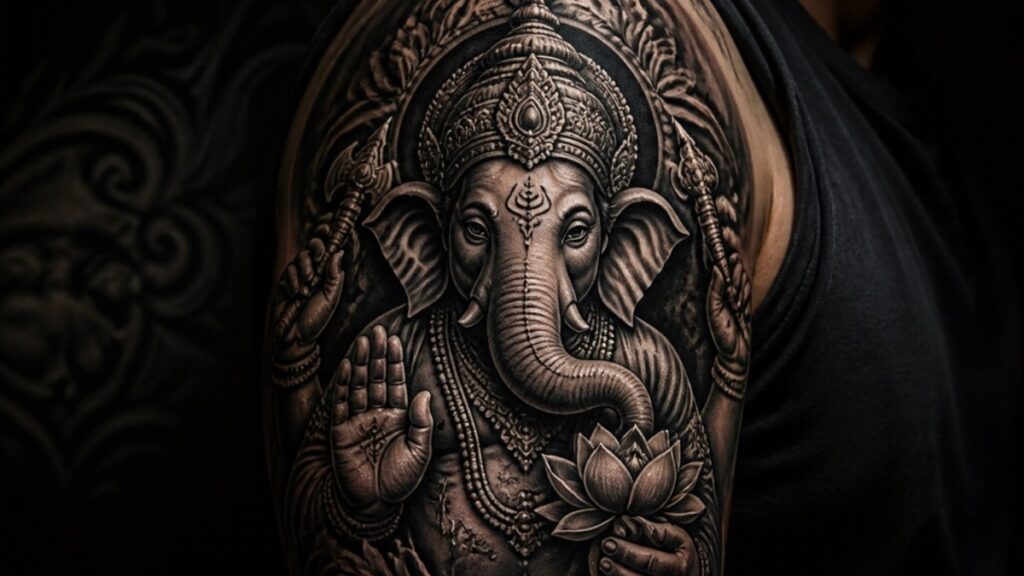
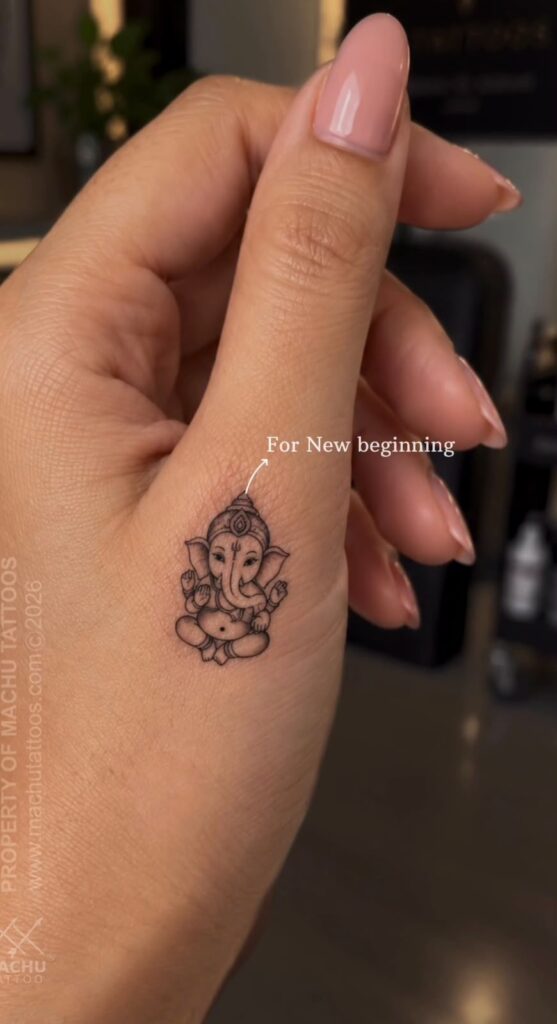
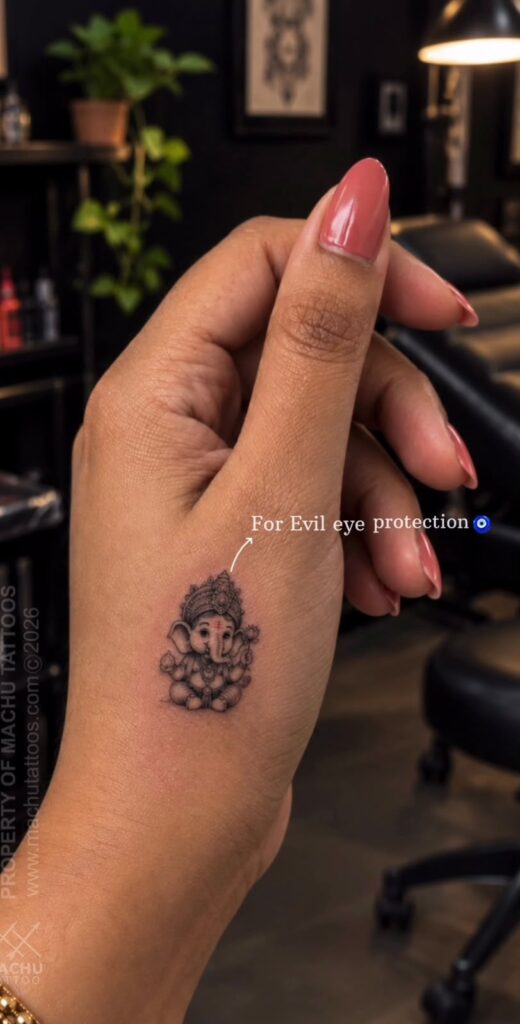
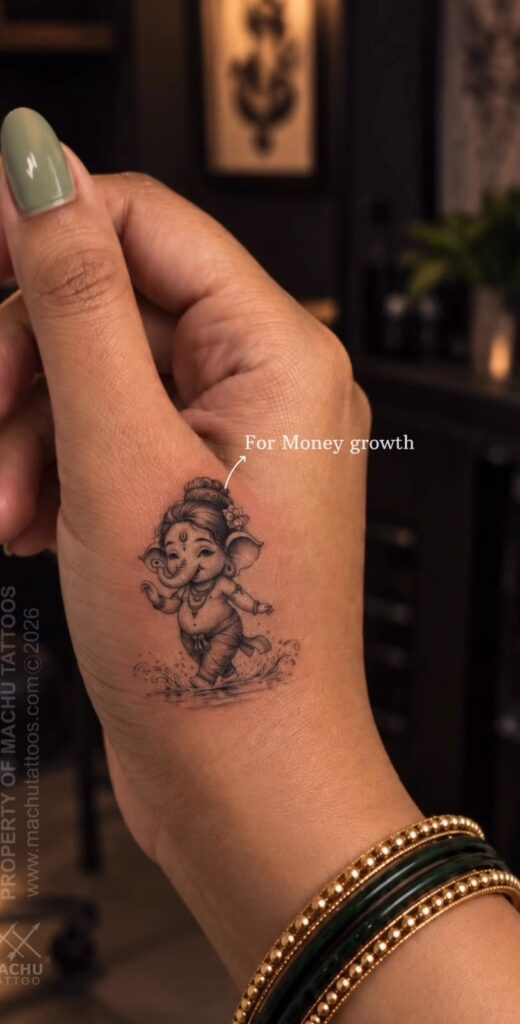
Ganesha is probably the most requested deity tattoo in India, and for a reason that has nothing to do with trend. He is the one you call on before you start something — a business, a move, a marriage, a recovery. People get this tattoo at a turning point, not on a whim.
This guide covers what the symbol actually means, the six designs that work well as tattoos, where to place one, how big it needs to be, what it costs, and the cultural rules worth knowing before you book.
- Meaning: Vighnaharta — the remover of obstacles. Also new beginnings, wisdom and patience.
- Most popular placement: back of the hand and forearm.
- Minimum size that ages well: 2 inches for line art, 5 inches for anything with detail.
- Price: not listed online — message us with the design and you get a quote for your piece.
- Cultural rule most people ask about: keep it above the waist, and avoid the foot and calf.
- Pain: moderate on the forearm and upper arm; sharper on the hand, chest and ribs.
What does a Ganesh tattoo mean?
Ganesha is Vighnaharta — the one who removes obstacles. That is the meaning almost everyone is after. But the symbol carries a few more layers, and knowing them usually changes what people end up getting inked.
New beginnings. Ganesha is invoked first, before any other deity, at the start of anything — which is why this tattoo is common after a career change, a recovery, or leaving something behind.
Wisdom over force. The large head means think big, the small eyes mean concentrate, the big ears mean listen more than you speak, and the small mouth means talk less. Clients who want the tattoo to mean something personal often ask us to emphasise one of these.
The broken tusk. Ganesha broke his own tusk to finish writing the Mahabharata. It stands for sacrificing something to finish what you started. If that is your reason, the tusk should be visible in the design — a lot of minimal designs leave it out.
The modak and the mouse. The sweet in his hand is the reward of a well-lived life; the mouse he rides is desire, kept under control. These rarely survive in small tattoos, so they are worth including only at 5 inches and above.
Is it okay to get a Ganesh tattoo?
This comes up in almost every consultation, so here is a straight answer. Getting a deity tattooed is widely accepted in India and we do them every week. What people actually disagree on is placement, not the tattoo itself.
The norm most families follow: keep a deity above the waist. The feet, calves and anywhere below the waist are considered disrespectful by a large number of people. Hand, forearm, upper arm, shoulder, chest and back are all fine.
A few other things clients bring up: avoid placing it where it sits under footwear or gets routinely covered in dirt, and think twice about the lower back. If you are unsure how your family will take it, the forearm and upper back are the two placements that almost never cause an argument.
We will tell you the same thing in person. If a placement is likely to cause you trouble at home, we would rather move it than have you regret it.
6 Ganesh tattoo designs that work
Not every Ganesha design survives on skin. Fine detail closes up over the years, and a face that is too small turns into a blur. These six hold up.

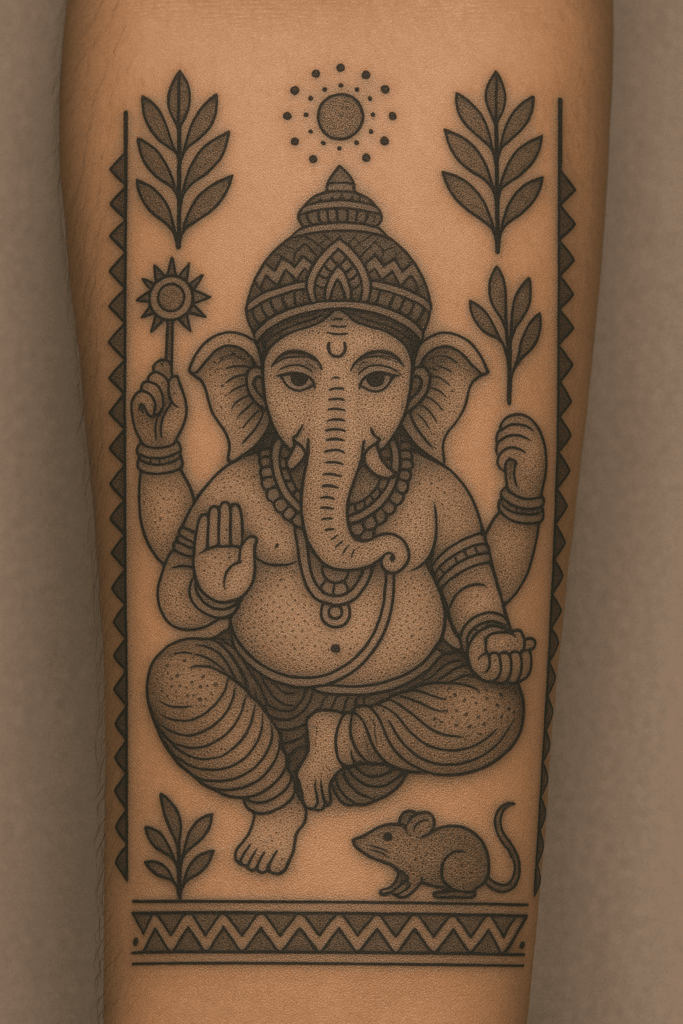

1. Minimal line-art Ganesha
A single continuous outline — crown, ears, trunk. One or two hours, ages better than anything else on this list, and reads clearly even at 2 inches. This is what we recommend for a first tattoo or a hand placement.
2. Ganpati face
Just the face and crown, no body. The most requested version for the back of the hand because the shape fits the space naturally. Works at 3–4 inches; below that the eyes and tusks start merging.
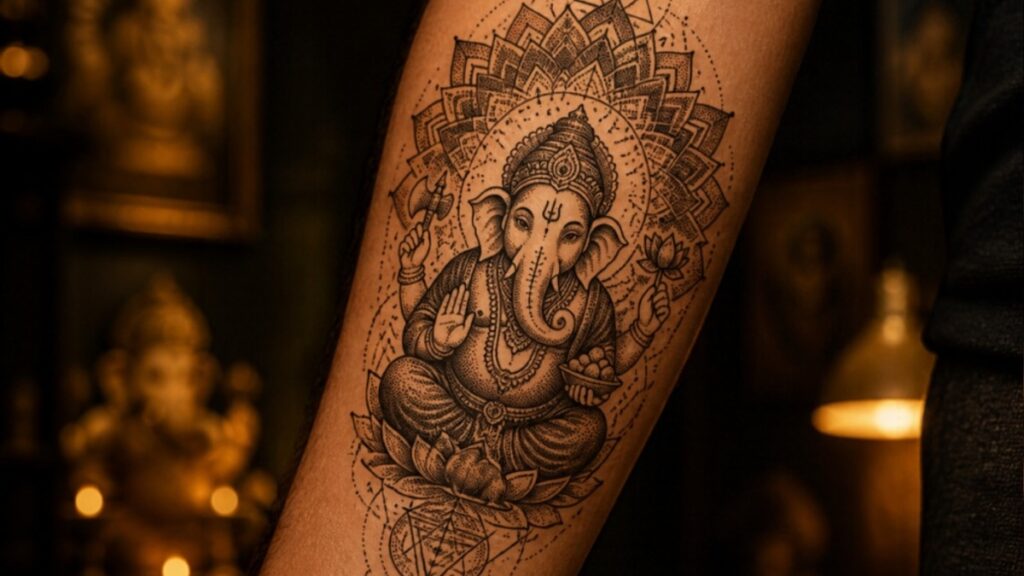
3. Mandala Ganesha
Ganesha set inside a mandala. The geometry gives the piece structure and makes it look intentional on a shoulder or upper back. Needs 5 inches minimum and 4–6 hours — mandala line work has to be precise or it looks wobbly within a year.
4. Dotwork Ganesha
Built from stippling rather than solid shading. Softer, almost like a pencil sketch, and it holds detail without going heavy on black. Takes longer than it looks: 4–7 hours.
5. Realistic Ganesha
Sculpture-like, with depth and texture. The most impressive and the most demanding — it needs 7 inches or more and a real portrait artist. Done small, realism is the design that fails fastest.
6. Ganesha with Om
The Om symbol forming or framing the figure. Simple, meaningful, and the easiest to adapt to an awkward space like the inner forearm or behind the ear.
Where to place a Ganesh tattoo
Placement decides size, and size decides how much detail is even possible. Pick the spot first.
| Placement | Space it needs | Pain | How it ages | Best style for it |
|---|---|---|---|---|
| Back of the hand | 2–3 in | High | Fades fastest – touch-up every few years | Ganpati face, minimal line art |
| Forearm | 3–5 in | Moderate | Ages slowly – best all-round | Any style |
| Upper arm / shoulder | 4–6 in | Low to moderate | Ages well | Mandala Ganesha |
| Chest / upper back | 6–9 in | Moderate to high | Ages best – flat canvas | Realism, large mandala |
| Neck / behind the ear | 1–2 in | High | Fine lines blur over time | Minimal line art only |
Back of the hand is the most requested and the most visible. It takes a Ganpati face well at 2–3 inches, but hands fade faster than anywhere else because of sun and washing — budget for a touch-up every few years.
Forearm is the best all-round choice. Enough flat space for detail, moderate pain, easy to cover at work, and it ages slowly.
Upper arm and shoulder suit mandala Ganesha because the curve of the deltoid works with a circular design.
Chest and upper back are where realism belongs. You get 6–9 inches and a flat canvas, which is the only way a realistic face stays readable in ten years.
Neck and behind the ear only work for minimal line art. Anything more turns muddy at that scale.
What size should a Ganesh tattoo be?
The single most common mistake is going too small for the style. Here is the honest minimum for each.
| Style | Minimum size | Recommended | Why |
|---|---|---|---|
| Minimal line art | 2 in | 2–3 in | Few lines, nothing to close up |
| Ganpati face | 3 in | 3–4 in | Eyes and tusks need separation |
| Ganesha + Om | 3 in | 3–5 in | Two elements need breathing room |
| Mandala Ganesha | 5 in | 5–7 in | Geometry blurs below this |
| Dotwork | 5 in | 5–7 in | Dots merge when crowded |
| Realism | 7 in | 7–9 in | Depth needs space, full stop |
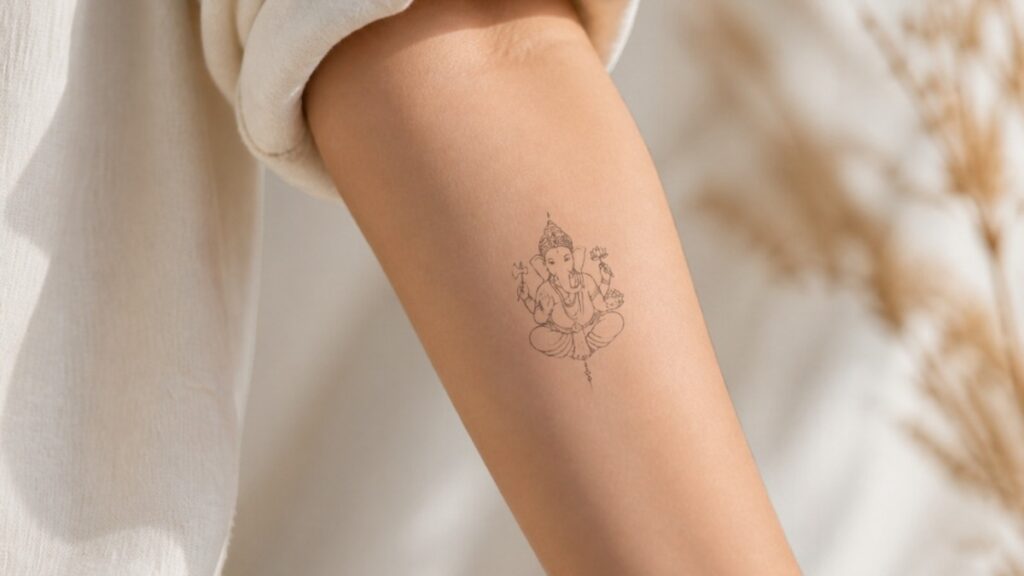
If the spot you want cannot take the minimum size, change the style rather than shrinking the design. A clean line-art Ganesha at 2 inches will look better in ten years than a cramped realistic one.
How much does a Ganesh tattoo cost in India?
We do not list prices for Ganesh tattoos online, and we are upfront about why. No two Ganesha designs take the same number of hours, so any figure on a web page would be wrong for most people who read it. You get your price when you contact us — send the design, size and placement on WhatsApp or call the studio, and an artist gives you a number for your piece, not an average.
What the table below shows is what that number is actually made of, so you know what you are paying for before you ask.
| Design and size | Time in the chair | What you are paying for |
|---|---|---|
| Minimal line art, 2–3 in | 1–2 hours | One short sitting, clean linework, no shading |
| Ganpati face, 3–4 in | 2–3 hours | Facial detail and soft shading around the eyes and tusks |
| Ganesha with Om, 3–5 in | 2–4 hours | Two elements that have to be balanced and spaced by hand |
| Mandala Ganesha, 5–7 in | 4–6 hours | Geometry that has to stay symmetrical across a curved limb |
| Dotwork Ganesha, 5–7 in | 5–7 hours | Dots placed one at a time — the slowest technique we do |
| Realism Ganesha, 7–9 in | 7–10 hours | Depth and tonal work, usually across more than one sitting |
Two things move the number most: how much black and grey shading the design needs, and whether it is custom-drawn for you or picked from a flash sheet. Custom work takes longer and is worth it for a deity tattoo you will carry for life.
If a quote comes in far below everyone else’s, ask what needles and ink they use — on a deity piece that is usually where the saving comes from. Message us with your design and you will have our number the same day, with no obligation to book.
Does a Ganesh tattoo hurt?
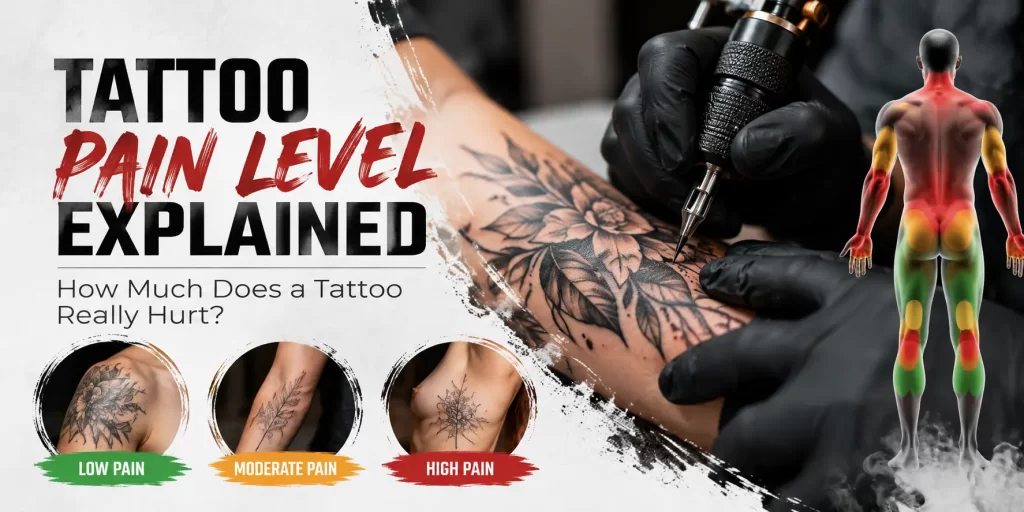
Where you place it matters far more than the design itself. On a 1–10 scale, based on what clients tell us:
| Placement | Pain | What it feels like |
|---|---|---|
| Outer upper arm | 3–4 | Easiest spot on the body |
| Outer forearm | 4–5 | Manageable for a full session |
| Shoulder | 4–5 | Comfortable, good for mandala work |
| Upper back | 5–6 | Fine except over the spine |
| Chest | 6–7 | Sharp near the sternum |
| Back of hand | 7–8 | Thin skin over bone, but short |
| Neck | 7–8 | Intense, keep sessions short |
A line-art Ganesha on the forearm is over before most people settle in. A realistic chest piece is split across sessions — nobody should sit ten hours in one go.
Aftercare for a Ganesh tattoo
Hand and forearm placements need more care than most, because they get washed and exposed constantly.

Keep the wrap on as long as your artist says. Wash twice a day with plain water and fragrance-free soap, pat dry, and use a thin layer of moisturiser — thin, not thick. No pools, no gym, no direct sun for two weeks. Do not pick the flakes; that is how line work ends up patchy.
For hand tattoos specifically, use sunscreen once healed. Sun is the main reason hand tattoos fade faster than anywhere else. Our full tattoo aftercare guide covers skin types in detail.
Where to get a Ganesh tattoo done
For a deity tattoo, line quality is everything — a shaky outline on a face is obvious forever. Check the artist’s healed work, not just fresh photos, and ask to see a Ganesha they have done before.
Machu Tattoos has studios in Bangalore (Marathahalli, Kammanahalli, BTM Layout, Indiranagar, Vasanth Nagar), Hyderabad, Chennai, Coimbatore, Vizag and Pune. We use single-use needles and cartridges, organic vegan-certified inks, and European hygiene standards. The consultation is free, and nothing goes on skin until you approve the drawing.
Frequently asked questions
Is it disrespectful to get a Ganesh tattoo?
Getting Ganesha tattooed is widely accepted in India. What people object to is placement, not the tattoo. The common rule is to keep a deity above the waist — hand, forearm, arm, shoulder, chest or back are all fine, while the feet, calves and lower body are considered disrespectful by many.
How much does a Ganesh tattoo cost in India?
There is no fixed rate. A small line-art Ganesha is one short sitting, while a large realistic piece can run across several. The price depends on size, detail, the hours it takes and whether the design is custom-drawn for you. Send us the design and placement on WhatsApp and we will quote it.
What is the best placement for a Ganesh tattoo?
The forearm is the best all-round choice — enough space for detail, moderate pain, easy to cover and it ages slowly. The back of the hand is the most popular and most visible but fades faster. Chest and upper back suit large realistic designs.
What size should a Ganesh tattoo be?
Minimal line art works from 2 inches. A Ganpati face needs at least 3 inches so the eyes and tusks stay separate. Mandala and dotwork need 5 inches, and realism needs 7 inches or more. If the spot cannot take the minimum, change the style rather than shrinking the design.
Does a Ganesh tattoo hurt a lot?
Pain depends on placement, not the design. The outer upper arm and forearm are 3–5 out of 10. The chest is 6–7, and the back of the hand and neck are 7–8 because the skin is thin over bone. Hand sessions are short, so the pain does not last long.
What does the broken tusk on Ganesha mean?
Ganesha broke his own tusk to finish writing the Mahabharata. It stands for sacrificing something in order to complete what you started. If that meaning matters to you, make sure the tusk is visible — many minimal designs leave it out.
How long does a Ganesh tattoo take?
Minimal line art takes 1–2 hours and a Ganpati face 2–3 hours. Mandala Ganesha runs 4–6 hours, dotwork 4–7 hours, and realism 6–10 hours, usually split across two or more sessions.
Tattoo and piercing studio since 2007, with studios in Bangalore, Hyderabad, Chennai, Coimbatore, Vizag and Pune. Organic vegan-certified inks, single-use needles and European hygiene standards.
Last updated: 3 November 2026